

The launch coincides with Florida Behavioral Health Day, Oct. 15
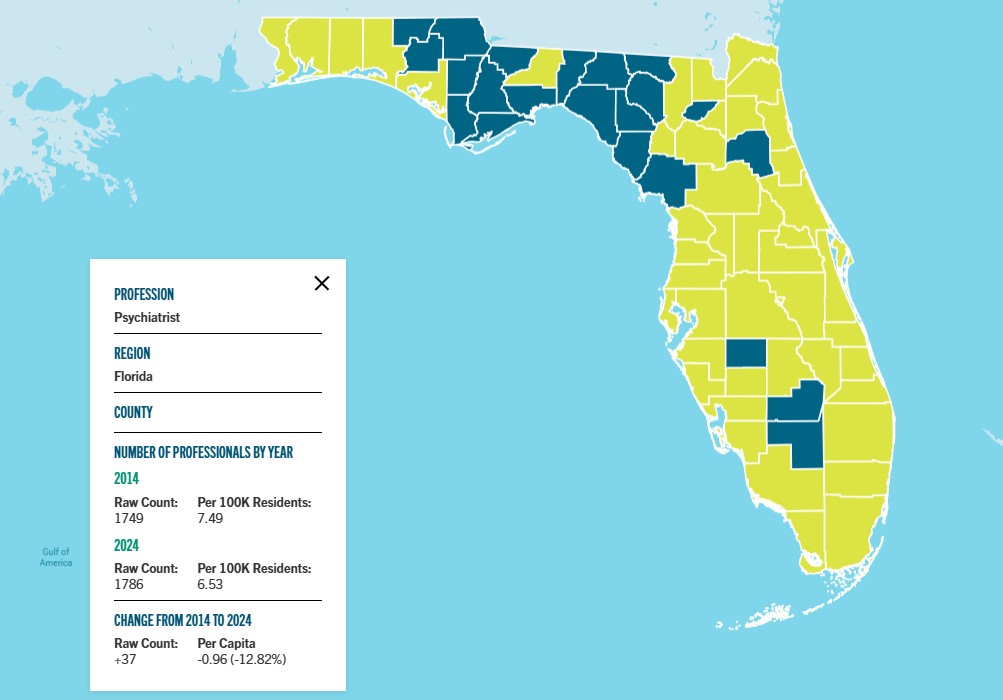
The Florida Center for Behavioral Health Workforce (FCBHW) at the University of South Florida today launched the state’s first interactive dashboard that projects behavioral health workforce supply and demand through 2035. The dashboard
equips policymakers, providers, educators, and advocates to confront Florida’s critical
shortage of behavioral health professionals. The launch comes ahead of Florida Behavioral
Health Day on Oct. 15, which spotlights the urgent need to close access gaps and prepare
the state’s workforce for the future.
“Florida now has a way to see not just where the workforce stands today, but where
it’s headed,” said Julie Serovich, dean of the USF College of Behavioral and Community Sciences, which houses FCBHW. “This dashboard helps us anticipate challenges and gives leaders
the evidence they need to strengthen the workforce across professions in meaningful
ways.”
Stakeholders can use the tool to see where behavioral health professionals are and
where they are not, spot shortages before they become crises, and measure how state
and local policies affect access to care. The dashboard delivers state, regional,
and county-level insights and projections for six licensed behavioral health professions
in Florida: psychiatrists, psychologists, psychiatric-mental health nurse practitioners,
clinical social workers, marriage and family therapists, along with mental health
counselors.
By making workforce data easily accessible, the dashboard provides a foundation to
plan systems, evaluate programs and investments, and spur policy change.
Now that we know the projected trends, our responsibility is to close the gaps. By
growing, retaining, and innovating our workforce, we can bend these trends toward
greater access and better outcomes.FCBHW Executive Director Courtney Whitt, PhD
The launch comes as the state faces several challenges:
- Florida has the second highest prevalence of mental illness and third highest rate of substance use
disorder in the nation, yet ranks among the lowest for access to behavioral health care (Mental
Health America, 2024 State of Mental Health in America Report). - Florida has 219 federally designated mental health shortage areas, among the highest in the country (Health Resources and Services Administration,
2024). - Current workforce levels meet just 24% of the state’s total estimated need (HRSA, 2024).
In 2024, USF was awarded $5 million in recurring state funds to create FCBHW to help combat these issues.
Dashboard data reveals the most urgent being the steady decline of psychiatrists across
Florida, even as demand rises. More than 40 percent of the current psychiatrist workforce
is at or beyond retirement age, and replenishment is not keeping pace.
The dashboard also sheds light on geographic disparities. Some Florida counties have
no psychologists or psychiatric prescribers at all, and in some cases, residents live
far from the nearest county with providers.
“Developing projections like these is a complex task that many states continue to
refine,” said Jacob Gray, the center’s lead statistician. “Florida’s approach offers
a strong example for other states to learn from as they build their own models.”
FCBHW soon plans to expand the scope to capture a fuller spectrum of the workforce,
including paraprofessionals and those certified to serve in Florida’s schools. The
dashboard can be found here.
About the Florida Center for Behavioral Health Workforce
The Florida Center for Behavioral Health Workforce (FCBHW) was established by the
Florida Legislature in July 2024 to strengthen the state’s behavioral health workforce
and ensure all Floridians have access to timely, high-quality care. Housed within
the University of South Florida’s College of Behavioral and Community Sciences and
the Louis de la Parte Florida Mental Health Institute, the FCBHW advances data-driven
solutions through research, education, policy, and collaboration. FCBHW serves the
entire state through its mission to grow, retain and innovate Florida’s behavioral
health workforce.

